Blog
What We Heard: Industry, Digital and Technology B7 Ministerial Side Event
On December 8, senior business leaders, government representatives and international partners from across the G7 came together in Montreal for the Industry, Digital and Technology B7 Ministerial Side Event, hosted by the Canadian Chamber of Commerce in collaboration with Innovation, Science and Economic Development Canada (ISED).
Share:




On December 8, senior business leaders, government representatives and international partners from across the G7 came together in Montreal for the Industry, Digital and Technology B7 Ministerial Side Event, hosted by the Canadian Chamber of Commerce in collaboration with Innovation, Science and Economic Development Canada (ISED). The event built on the momentum of the 2025 B7 Summit and official B7 Communiqué while also mirroring the key topics that were being discussed at the G7 Ministerial.


Catherine Fortin Lefaivre, Senior Vice President, International Policy and Global Partnerships at the Canadian Chamber of Commerce, welcomed attendees and set a collaborative and positive tone for the afternoon’s agenda, starting with a keynote address from Minister of Artificial Intelligence and Digital Innovation Evan Solomon.
Minister Solomon stepped away from hosting the G7 Ministerial to remind B7 attendees that technology should reinforce open markets, not fragment them, and that in an increasingly divided world, the G7 represents alignment. He acknowledged that while AI is a divisive technology that’s rewriting every sector of our economy, it is also a defining force of competitiveness. The second wave of technology, quantum, is approaching and will open entirely new markets, unlock discoveries and define what will happen in the months and years ahead. But the adoption of technologies like AI and quantum moves at the speed of trust, which is why the federal government is trying to design a system that is as agile as the technologies they govern. Minister Solomon promised that the next phase of Canada’s AI and quantum strategy will be not only robust but competitive, bolstering commercialization and putting Canada in the driver’s seat.


Panel 1: Propelling AI Adoption Across the G7


Moderator: Nicole Foster, Head of AWS Public Policy (Canada), Amazon
Speakers: Max Fenkell, Global Head of Policy and Government, Scale AI; Nicole Isaac, Vice President, Global Public Policy, Cisco; Kate Purchase, Senior Director, International AI Governance, Microsoft; Jean-Simon Venne, Co-Founder and Chief Technology Officer, Brainbox.
The panel started out with a strong message to attendees — AI is not just an opportunity but an imperative. They emphasized that infrastructure matters because connectivity is critical to scaling compute and ensuring more people have access to these technologies.
The panel made a case for layering specific data on top of general-purpose models to ensure you have a model that knows your use case and can provide subject matter expertise. They also addressed major barriers to diffusion and adoption — electricity/energy, lack of connective infrastructure, and worker skilling — as well as some less obvious barriers like language. The question posed was, how do we bring more languages online to increase adoption? Building more purpose-built tech stacks, instead of general-purpose models, will allow for more cultural and language nuances to “localize” AI.
Panel 2: Supply Chain Resiliency

Moderator: Yvonne Denz, President and CEO, Canadian German Chamber of Industry and Commerce
Speakers: Kevin Allison, Founder and President, Minerva Technology Futures; Karen Mazurkewich, Vice President, Stakeholder Relations and Communications, Toronto Pearson International Airport; Annika Schoch, Vice President, Finance and Business Services, Roche.
The panellists provided examples of how they’re using AI to help ensure reliable supply chains. This included AI sensors to record when airplanes are getting on and off gates to improve efficiency, as well as using AI to forecast demand and proactively manage pharmaceutical inventory. Panellists discussed ways to encourage information sharing among companies whose supply chains are their competitive advantages.
The panel also talked about how supply chains are increasingly influenced by government policy with changes in one country’s policies influencing another country’s supply chains. Attendees were encouraged to think about where their biggest vulnerabilities could be based on where they think the geopolitical environment is going.

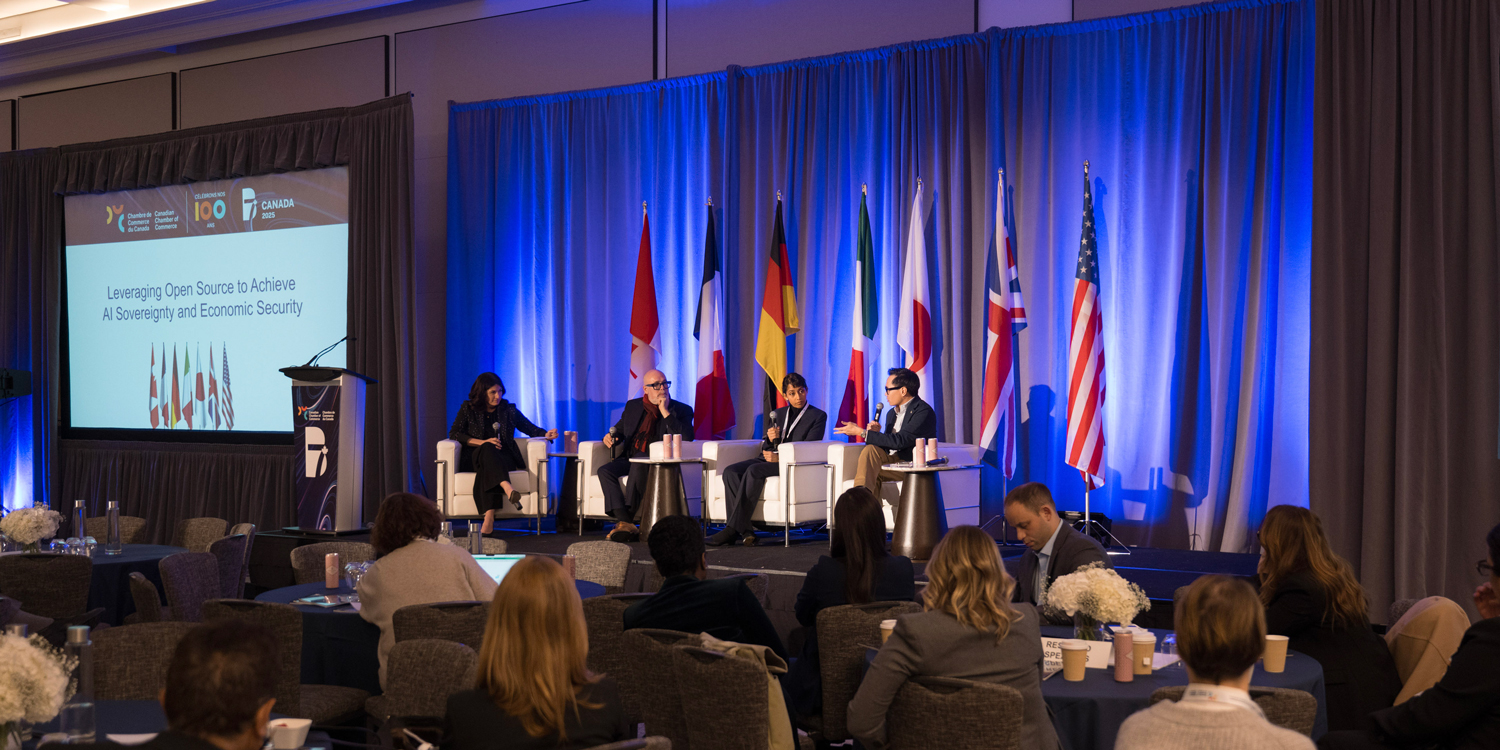
Panel 3: Leveraging Open Source to Achieve AI Sovereignty and Economic Security


Moderator: Valeria Pisano, President and CEO, Mila
Speakers: Kevin Chan, Senior Director, Global Policy Campaign Strategies, Meta; Irene Solaiman, Chief Policy Officer, Hugging Face; Marc Surman, CEO, Mozilla.
The panellists, all strong advocates of open source AI, emphasized its ability to accelerate innovation, democratize access, and lower the cost of adoption. Though sovereignty and open source can appear at odds, the panelists argued that open source lets users take something that’s been started and then “own” it, instead of “renting” it. Organizations or governments can take open source and then make it suitable for their cultures, including by building in local languages and dialects.
And because not every country can create a vibrant AI driven economy from the ground up, open source lets countries catch up almost immediately since it’s already built and usually only a few months behind pioneer models. The panelists called it an essential starting point for any middle power and encouraged governments to be more vocal about the benefits of open source.
Panel 4: Enhancing Our G7 Defence Industrial Base Coordination


Moderator: Joanne Lostracco, Director General (Washington Sector), Defence Procurement, Public Services and Procurement Canada
Speakers: Johan Gott, Director, Corporate Advisory, Eurasia Group; Martin Rivest, Head, CortAIx; Rajeev Roy, Chief Technology Officer, D-TA Systems Group; Keith Webster, President, Defense and Aerospace Council, U.S. Chamber of Commerce.
This panel addressed challenges in government procurement, pointing to a persistent disconnect between producers and end users. Panellists called for government to help clear the path from R&D to implementation. One panellist emphasized that economic security only happens where there’s national security — nations need to spend the money to procure the necessary materials to outfit the military. This is a prerequisite for national security, which is itself necessary for enabling economic security. Panellists recognized that AI is not just an add on — it’s a backbone that must be deployed to foster the ecosystem that will start bringing the innovation to our militaries.
Panel 5: Resilient Approaches to Building AI Infrastructure Across the G7


Moderator: Marc-Etienne Ouimette, Founder, Cardinal Policy
Speakers: Shannon Bell, Executive Vice President, Chief Digital Officer and Chief Information Officer, OpenText; Chris Lehane, Chief Global Affairs Officer, OpenAI; Chris Mada, Vice President, Customer Digital Solutions and Product, Telus; and Imran Shafi, OBE, Senior Vice President, NScale.
The final panel of the day focused on operational sovereignty — who owns the kill switch if something goes wrong? — and differentiating what needs to remain sovereign and what can continue to operate in the public domain. Panellists acknowledged that standing up data centres at the size and scale for general purpose data sets is hugely expensive; they should set up centres only for what is critical, like protected data sets that must remain sovereign. The panel warned that there’s a danger in throwing money at infrastructure that the countries don’t need. Instead, governments should help facilitate demand and ensure access to compute for researchers who want to work in the country or work with the local business community to incentivize them.
Panellists encouraged attendees to invest as locally as possible to have a strong workforce and strong economic levers, but not to invest foolishly. Harkening back to an earlier panel, they told attendees to find a blueprint or start from open source rather than beginning from the ground up.
Spotlight on Technology

In addition to the five panels and their excellent speakers and moderators, we heard from Robbert Barcuh, Senior Vice President of Public Affairs – Europe and Multilateral Relations, Universal Music Group, about the use of AI in the music ecosystem and how artistry is being protected while also being expanded upon with the newest technology and tools.
We also heard from Ivan Zhang, Co-founder of Cohere, during a fireside chat with Valerie Pisano, about large language models and the future of global AI leadership. Zhang said that Canada is in a privileged position because we have the compute, talent and innovators that are necessary for AI leadership. However, he emphasized that we need to build more of an ecosystem to convince talented young people to grow their careers in Canada.

Final Moments


To conclude the evening, our President and CEO, Candace Laing, provided some reflections on the day and her time at the G7 Ministerial event nearby before handing the stage over to Jill Briggs, Manager, Public Policy at Meta. Then Minister Evan Solomon returned to greet delegates for the G7/B7 Welcome Reception before ceding the stage to Minister of Industry and Minister responsible for Canada Economic Development for Quebec Regions Mélanie Joly. We are grateful for the participation of the Ministers.

We were also honoured to have a surprise and special appearance from Mayor of Montreal Soraya Martinez Ferrada during the day.
B7 2026
This Ministerial marks the end of the Canadian Chamber’s official duties as the B7 2025 President. We look forward to handing over the privilege and responsibility of representing the B7 on the world stage in 2026 to our colleagues in France.
Look back on our year as B7 President
Thank You to Our Sponsors
This event would not have been possible without the support of our sponsors.

Other Blogs

As Separatist Vote Looms, Canada Must Renew Its Relationship with Alberta
Policy Matters: Canada’s Next Competitive Advantage Starts at Home