Blog
A $31-Billion Ticket to Ride: How the West Coast Pipeline Can Boost Canada’s GDP
This blog was provided by ATB Financial, Member, Western Executive Council
Share:




This blog was provided by ATB Financial, Member, Western Executive Council
There’s a train getting ready to leave the station. And in the words of Fatih Birol, Executive Director of the International Energy Agency, “the cost of missing this train will be incredible.”
Those words were shared at the Canada Growth Summit on May 7, 2026. Weeks later, Prime Minister Mark Carney and Alberta Premier Danielle Smith announced a major policy breakthrough at a joint press conference. The landmark MOU between Alberta and Canada—which ultimately lays the groundwork for a West Coast Pipeline—had officially cleared its biggest hurdle yet, with both parties agreeing on an industrial carbon pricing trajectory that will reach $130 per tonne by 2035.
This step towards regulatory certainty arrives at a key moment for industry. Pressure is mounting for safe, reliable energy from stable nations like Canada. Ongoing geopolitical shifts mean supply-chain risks will likely keep energy prices elevated for years to come. Capitalizing on this disruption gives the Carney Government a critical window to fulfill its most ambitious goals: stimulating a trillion-dollar capital infusion within five years, doubling global trade outside the United States by the mid-2030s, and solidifying Canada as a preeminent global energy leader.
Still punching our ticket
While the carbon pricing agreement is a vital step forward, a signed memorandum does not equal steel in the ground. The reality is that the West Coast pipeline remains conditional on a complex web of regulatory and industrial moving parts:
- The Stalled Pathways Deal: Prime Minister Carney has made it clear that the pipeline is strictly contingent on the progress of the Pathways Carbon Capture and Storage (CCS) project. While Ottawa and Alberta reaffirmed their support, a crucial trilateral agreement with the energy industry, originally planned for April 1, has yet to be signed.
- The Regulatory Clock: To secure the powerful “project of national interest” status under the Building Canada Act by the government’s October 1, 2026 deadline, several major conditions must be met—most notably, achieving sufficient and meaningful consultation with Indigenous communities.
- Timeline vs. Forecasts: The government’s ambitious target of a September 2027 start date applies healthy pressure to get a deal done. However, economic forecasters are holding their breath. Until a final investment decision (FID) is reached and an official corporate proponent steps forward, these numbers cannot yet be factored into growth projections.
But if federal, provincial, and Indigenous partners can collaborate with the energy sector to move through these hurdles, the economic payoff will be massive.
Unlocking the bottleneck
As global demand for energy supply safe havens grows, the ability for Canadian energy producers to meet that demand remains constrained. While the industry currently enjoys a window of spare capacity to Pacific markets following the TMX expansion, a survey conducted in Spring 2026 by ATB Cormark Capital Markets found that 67% of energy industry respondents now expect Canada to face crude export constraints before 2029—a sharp increase from the 51% reported in Fall 2025.
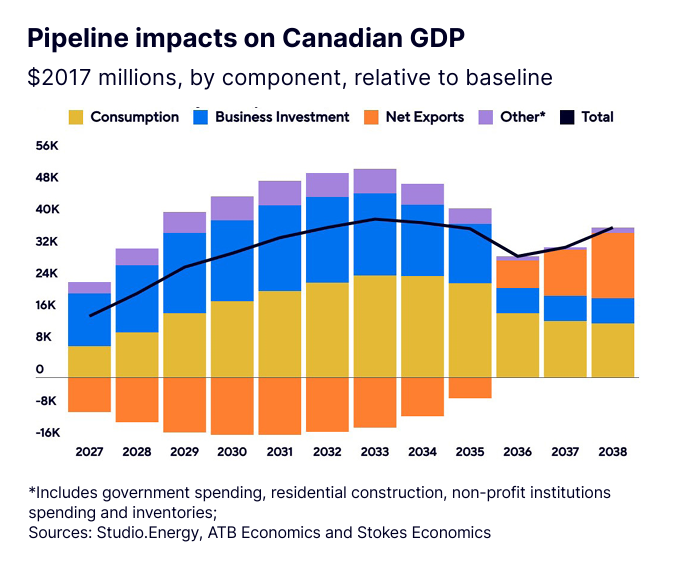
The stakes for resolving these bottlenecks are significant. A recent joint study by ATB Economics and Studio.Energy, The GDP Payoff of Additional Oil Pipeline Capacity, concluded that expanding Canada’s oil export infrastructure by 1.5 million barrels per day could inject an average of $31.4 billion into national real GDP annually over the next decade—representing a vital 1.1% structural boost to the economy. The report also estimates the buildout will support an average of 112,000 additional jobs in Canada.
At a time when Canada’s political decision-makers are looking for ways to reverse stalling national output and move past a decade-long struggle to raise per capita GDP, Canada’s energy sector offers us our ticket to ride.
Other Blogs

Five Priorities Canada Should Consider for the Next Agricultural Policy Framework

Calgary Stampede Mixer: Where Western Canada’s Leaders Came Together